On the second day after our arrival at the ashram, the moment we had travelled halfway around the world for finally arrived. It was time for me to visit the legendary samadhi shrine of Swami Muktananda.
My parents had brought me to India in the hope that a miracle might relieve my narcolepsy. At the heart of the ashram stood the shrine where Muktananda’s body had been interred after his death. Nearby was the marble courtyard where Gurumayi held darshan, and beside it stood the main temple where devotees gathered for chanting and meditation.
The shrine itself was fashioned from gleaming white marble. After Muktananda passed away, his body was placed in a meditative posture, covered with sacred substances, and sealed within a marble casket according to ancient Hindu rites. These ceremonies involved days of continuous mantras and ritual observances. When we arrived, he had only been entombed a relatively short time before, and many devotees believed the spiritual energy surrounding the shrine was especially strong.
Entering the Shrine
As devotees, my parents and I were permitted to enter. We made our offering and performed pranam, bowing in reverence, before walking around the large square marble structure that rose from the centre of the room. Guide ropes prevented anyone from approaching too closely.
The walls were lined with framed photographs of Muktananda, his guru Bhagavan Nityananda, and other, more mysterious figures from the Siddha lineage. Little was ever said about some of these saints. They seemed to belong to a hidden world whose stories had largely been lost to time.
Beneath the shrine was a basement meditation room known simply as “the Cave.” It was dimly lit and cool, with cushions lining the walls. The Siddha Yoga mantra “Om Namah Shivaya” played softly in the background. Devotees could enter at any hour to sit in silence and meditate.
The Vision in the Cave
After performing pradakshina—circumambulating the shrine three times—my father and I descended into the Cave.
My father sat cross-legged against the wall while I lay down beside him.
Many years later he told me that, as he meditated, he saw streams of white light descending from the ceiling. This was remarkable, because he was not someone who usually reported mystical experiences. In fact, such things were exceedingly rare for him.
After some time he nudged me, assuming I had fallen asleep.
According to him, I opened my eyes and said, “I haven’t been sleeping. I’ve been lying here watching the lights.”
This was taken as a very auspicious sign. My parents felt a surge of hope that perhaps some healing had already begun.
Life in the Ashram
We soon settled into the daily rhythm of ashram life.
We rose around six each morning, drank a cup of chai, and attended the chanting of the Guru Gita. Breakfast was served in the western style restaurant and eating hall known as Amrit. Afterward everyone began seva—voluntary work performed as a spiritual practice.
At around eleven o’clock, people hurried back to their rooms to freshen up before darshan in the marble courtyard beside the samadhi shrine.
At that time, Gurumayi Chidvilasananda had made an unexpected visit to the ashram, so only twenty or thirty devotees were present. In later years, her darshans would attract hundreds or even thousands, but during this visit it felt as if we had her almost to ourselves.
One by one we would approach, bow, and receive a gentle tap on the head with a fan of peacock feathers. Then we would sit quietly on cushions spread across the marble floor, simply watching her in silence.
It sounds strange now, but at the time it felt entirely natural.
Gurumayi’s Gift
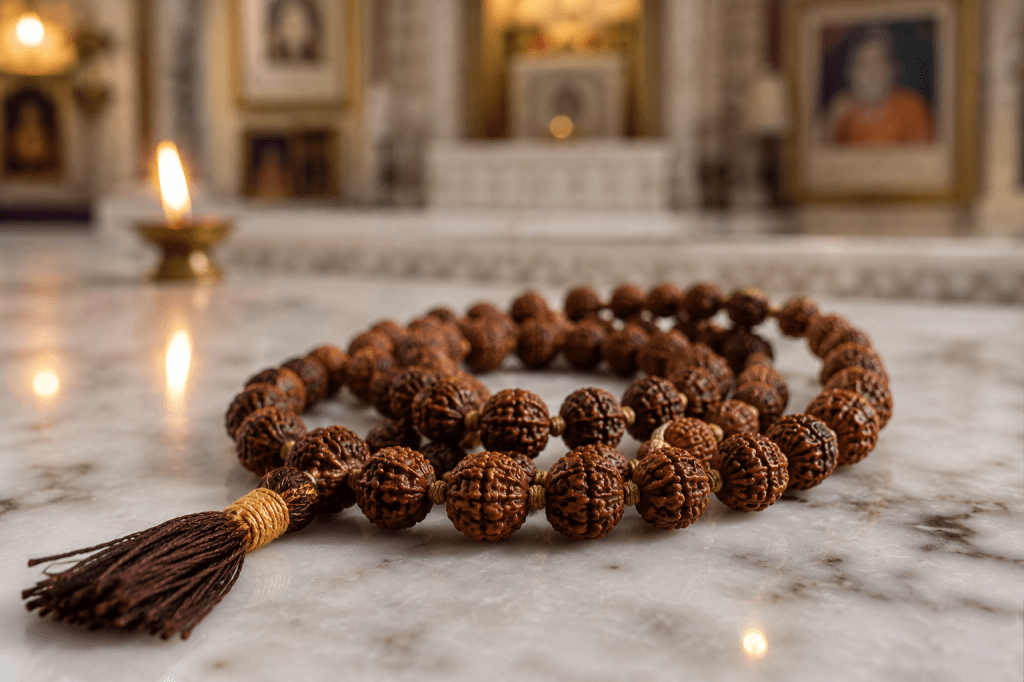
During one of these intimate darshans, Gurumayi presented me with a rudraksha mala. She placed it around my neck and gently stroked my head.
Rudraksha beads are regarded as highly sacred in Hinduism and are traditionally associated with Lord Shiva. They are often called the “tears of Shiva” due to their fruit having a bright blue teardrop shape.
At the time, my narcolepsy was causing frequent nightmares and frightening dream states. Receiving the mala felt like a profound blessing and a tangible form of divine protection.
My parents and I were deeply moved.
I wore the mala constantly and never took it off. Over time, my nightmares became noticeably less severe. To me, it felt as if the beads were shielding me from some unseen negative force.
Whether that protection was psychological or spiritual hardly mattered. What mattered was that it helped.
Exploring the Ashram Grounds
There were very few children at the ashram, so I spent much of my time exploring on my own.
I played with crabs in a nearby creek, wandered through expansive gardens, and admired life-sized statues of saints and mystics set among the trees and pathways.
One detail that particularly amused my family was the ashram’s security guards. Every so often they could be seen marching stiffly or standing at attention, trying to appear imposing, though to us they looked endearingly awkward.
An Early Wound
One seemingly small incident foreshadowed a pattern that would repeat throughout my relationship with Gurumayi.
I was playing in the gardens with the only other boy staying at the ashram when Gurumayi drove past in her golf buggy. She stopped and spoke briefly to the boy, then invited him to hop aboard and drove away.
I was left standing there alone.
My father later told me that I was deeply upset and kept asking, “Why didn’t she choose me? What’s wrong with me?”
Seeing this hurt my father. For the first time, he began to question whether Gurumayi’s holiness was as flawless as it appeared.
Over the years, this dynamic would recur. At times Gurumayi showed me extraordinary attention and concern for my healing and well-being. At other times, she seemed to ignore me or favour others right in front of me.
I came to interpret these experiences as spiritual tests. I told myself they were opportunities to develop resilience and detachment.
Whether that interpretation was true or simply a way of making sense of painful experiences, I cannot say.
The “Clock Winders”
From the very beginning, my parents and I noticed the officious behaviour of some of the staff who held positions of authority.
They were not overtly malicious, but they embodied the petty bureaucracy found in many organizations.
We jokingly referred to them as “the clock winders.”
Over the years, as Siddha Yoga grew larger, more centralized, and increasingly directed from America, this bureaucratic tendency became more pronounced. The transformation of the organization is a story worthy of its own chapter.
Chanting and Meditation
A central part of ashram life was chanting.
Morning and evening, everyone gathered in the large white marble hall opposite the samadhi shrine.
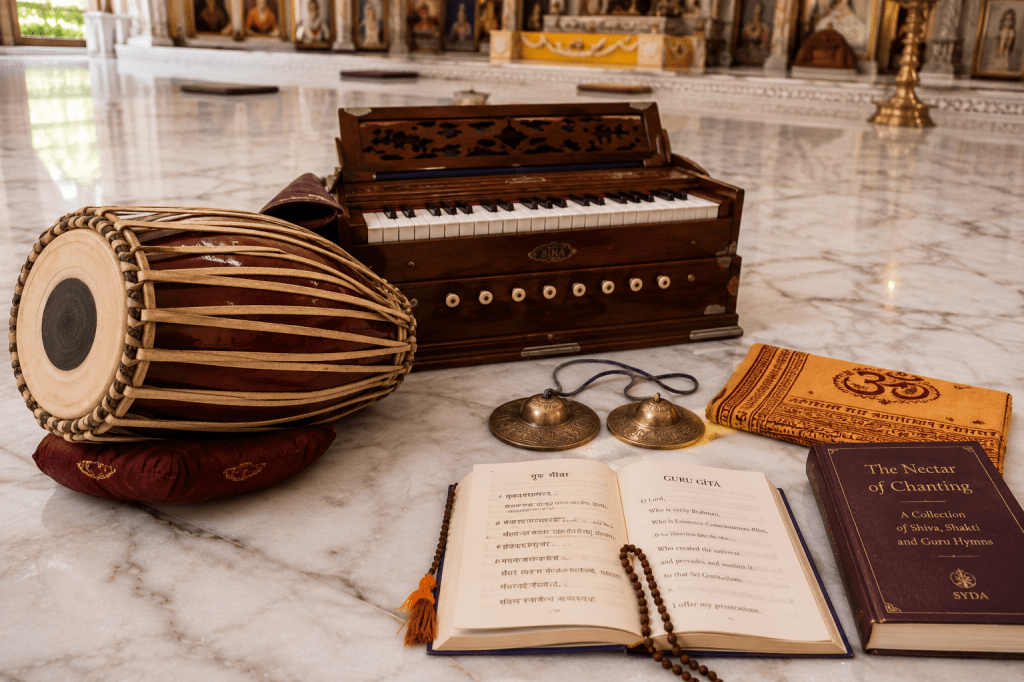
The morning chant was the Guru Gita, a scripture extolling the guru as the highest embodiment of truth. Evening programs often included the Shiva Mahimna Stotra or the Vishnu Sahasranama—the Thousand Names of Vishnu.
All of these were printed in The Nectar of Chanting, with Sanskrit text and English translations.
I quickly learned to follow the Sanskrit syllables as they were sung to the accompaniment of a harmonium.
After the formal chant came devotional singing. The harmonium player and drummer began slowly, singing a line which the congregation repeated. Gradually the pace increased until everyone was clapping, swaying, and singing with great energy.
Then, suddenly, the music would stop.
A deep stillness would descend.
Meditation began.
Discovering the Drum
I was captivated by the music, especially the drum.
A kind drummer took me under his wing and taught me the basic rhythms. Before long, I was invited to play during some of the smaller chanting sessions.
This marked the beginning of what became an important part of my life in Siddha Yoga.
Years later, I would become one of the principal drummers for programs at the Sydney ashram, culminating in the unforgettable experience of playing for Gurumayi during her visit to Australia.
Meals in Annapurna
Lunch and dinner were served free of charge in a vast marble hall called Annapurna.
My father and I sat cross-legged on mats while volunteers moved along the rows serving rice, dhal, vegetable curries, and chapatis onto stainless steel plates. My mother would sit in a special area reserved for people who couldn’t eat the spicy menu prepared for general consumption.
Anyone who came to the ashram could eat.
The hall remained almost entirely silent except for the sounds of people eating.
Meals were eaten with the right hand only, in accordance with Indian custom. I quickly learned to tear with one hand pieces of chapati and use them to scoop up the food.
The scale of the kitchen amazed me. The cooking pots were enormous—large enough, it seemed, for an adult to lie down inside them—and were stirred with paddles that resembled boat oars.
Visiting Ganeshpuri
Each day, horse- or donkey-drawn carts waited outside the ashram to transport visitors to the nearby village of Ganeshpuri.
The fifteen-minute ride was my first close encounter with the realities of rural India. I was disturbed by the rough treatment of the thin, overworked animals, but there was no other practical means of transport.
Ganeshpuri was centred around the samadhi shrine of Bhagavan Nityananda. Hundreds of pilgrims visited each day, and the village’s main street was lined with shops selling religious items, malas, statues, and photographs of the gurus.
I loved browsing these stalls.
During one visit, I bought a photograph of Gurumayi. The next day I asked her to sign it during darshan. She did, and I treasured the signed photo for many years.
Encounters with India
As a stright brown haired Western child, I attracted a great deal of curiosity.
Some Indian women seemed fascinated by my hair and face, and I was occasionally treated like a novelty.
I played cricket with local boys, and my father was frequently mistaken for Australian fast bowler Dennis Lillee because of his moustache and resemblance.
The first time this happened, a crowd rushed toward him so enthusiastically that he briefly thought he was in danger. Instead, he found himself surrounded by delighted cricket fans convinced they had just met their sporting hero.
Being Australian was an excellent icebreaker in India.
Bombay and the Journey Home
After our stay at the ashram, we spent several days in Mumbai (then still widely known as Bombay).
The city’s vast crowds, noise, and poverty were a striking contrast to the peace of the ashram.
We visited a music shop where my parents bought me a mridangam drum like the ones used in Siddha Yoga chanting.
We also took the ferry to Elephanta Caves, with their magnificent rock-cut temple dedicated to Shiva.
One memorable experience was ordering a beef sandwich at our hotel, completely forgetting that cows are sacred in Hinduism. It took well over an hour to arrive, and I suspect the kitchen staff were less than enthusiastic about preparing it.
Was I Healed?
In the end, my narcolepsy was not miraculously cured.
Yet something significant had changed.
Before the trip, I suffered from terrifying dream states that often continued after I awoke, blurring the boundary between sleep and waking life.
After India, my sleep became far more peaceful.
My family believed that Gurumayi’s blessing and the rudraksha mala had played a direct role in this improvement.
Whether the effect was spiritual, psychological, or some combination of both is ultimately beside the point.
The journey brought relief, hope, and a sense of being cared for.
More importantly, it established a relationship with Gurumayi that would shape many years of my life.
There would be numerous future journeys to India, and one of them would eventually lead me to an Aboriginal healer in the heart of Australia—a remarkable story I will share in a future post.
Disclaimer
This is a personal memoir based on my own direct experiences and memories as a child and young person in Siddha Yoga. All opinions expressed are entirely my own.
This blog is written for reflective and autobiographical purposes and does not claim to represent the full teachings or current practices of Siddha Yoga or the SYDA Foundation.
Names and details have been kept as I remember them.





Leave a Reply