The ongoing search for a cure for my narcolepsy has been a major theme in my life—a quest that has led me to cross paths with a wild array of spiritual teachers, magical healers, masters, and shamans over the years. But one of the most remarkable chapters of this search began under the vast, ancient sky of the Central Australian desert, triggered by a command from an Indian guru.
The Command in Ganeshpuri
It started in India at the Ganeshpuri ashram. My parents and I went up for darshan with Gurumayi, hoping for insight into my narcolepsy. My parents asked her directly, “Is there anything you can do for him?”
Her answer was completely unexpected: “You should go to the Aborigines for the healing. Ando and Ashley would know.”
We looked at each other, completely baffled. Who the hell are Ando and Ashley? We had never heard of them. My father had to hunt around the ashram, asking various devotees until he finally tracked them down. They turned out to be two young Australians who had been volunteering as teachers at the high school in Fregon, a remote Aboriginal settlement in Central Australia, for about twelve months. They knew the community intimately.
When we told them what Gurumayi had said, they went up to her themselves to confirm. They brought a photograph of a Pitjantjatjara man sitting on a rock—a local holy man they suspected Gurumayi was talking about.
“Is this the man?” they asked. Gurumayi looked at the photo and said, “Yeah, that’s him.”
His name was Uncle Jimmy. From that moment on, we were on our way, though it would take a grueling six months of back-and-forth communication just to organize the logistics and secure the necessary entry permits from the tribal Elders.
The Journey Inward
About six months later, back in Australia, the desert was hit by historic, massive rains. We packed our gear into our old Ford Cortina and headed inland. The land itself felt different—vast, sun-bleached, and full of a presence that seemed to hum beneath the surface.
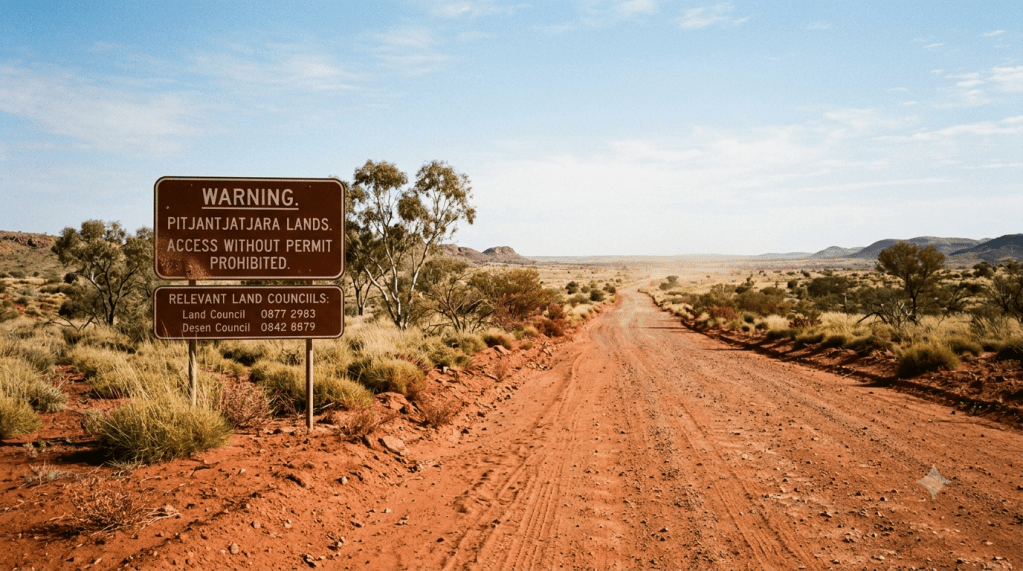
After driving in toward Alice Springs, we reached a remote roadhouse, filled up on petrol, and made our turnoff. Right at the edge of the track stood a massive sign warning that we were entering Pitjantjatjara territory and that entry without a permit was strictly forbidden.
The next 80 kilometers were pure bush tracks. We drove through tiny, isolated Aboriginal communities. After leaving the main road, we didn’t see another European face. The local drivers and residents knew we were coming; news travels fast in the desert, and people would come out just to watch our car pass by.
Because of the recent downpours, the dirt track was flooded with deep water in places. We frequently had to stop, get out of the Cortina, and physically wade through the massive puddles to test the depth and ensure we wouldn’t get the car bogged in the red mud. It was slow, high-stakes driving.
When we finally arrived in Fregon, it was a bit of a shock to our Western conditioning. The settlement consisted of a central building where food deliveries were distributed, a few homes for the white teachers—Ando and Ashley—and a small cabin where we were permitted to stay. The Aboriginal locals lived mostly in makeshift shanty shacks that looked more like a traditional campsite than a Western town. We had unconsciously arrived with the mindset of: “We have arrived to see the magic man, please make him available to us now.” Instead, we got nothing for the first week. The desert does not bend to a white man’s schedule.
Those days were slow and spacious. I spent hours drawing a detailed picture that might serve as a teaching aid, losing myself in the lines and patterns. At other times, I sat in the teachers’ house watching movies, one of them being Some Kind of Wonderful, a simple teenage romance that felt strangely grounding amidst the deeper spiritual purpose of our visit.
After about four days of waiting in the suspension of the desert, we finally had our first brief meeting with the healer, Uncle Jimmy. He was a gentle, softly spoken man who carried himself with a quiet ease. He spoke with a thick Aboriginal accent, making it quite difficult for my twelve-year-old ears to fully grasp his words, so he had someone with him to help guide the conversation. But during that brief exchange, he shared something that pierced right through the language barrier. He told us that when he was young, he had suffered from the exact same sleeping sickness—narcolepsy—but had been completely healed of it.
Looking back, that specific connection was probably the most significant part of the entire experience. In a world where my illness made me feel isolated and misunderstood, sitting in the red dirt across from an ancient tribal healer who could look me in the eye and say, “I know exactly what you are living through because I lived through it too,” felt like a profound validation. It wasn’t just a medical consultation; it was a rare moment of deep, empathetic alignment. He told us he was willing to help me, explaining that the sleeping problem was due to “strings” or a “worm” in my head that would need to be removed, and a date was set for the ceremony.
He also shared another story that gave us a window into his unique spiritual world. He told us about a time he was out herding his cattle in the bush and noticed the herd was suddenly splitting cleanly into two groups at a specific point on the ground. Intrigued, he walked closer to investigate the spot where the animals were dividing and found a Bible lying in the dirt. For Uncle Jimmy, this wasn’t a coincidence; it was a direct, powerful sign from the land itself. This singular event was what catalyzed him to incorporate Jesus directly into his existing belief system.
This kind of religious syncretism—blending ancient, thousands-of-years-old tribal lore with Christianity—is actually quite common across regional Australian Indigenous communities. Rather than completely abandoning their traditional Law, many Elders simply absorbed Christian figures into their cosmos, seeing them as different facets of spiritual reality. For Uncle Jimmy, the Bible in the red dust didn’t replace the Dingo Dreaming; it walked alongside it.
The Rhythm of the Inma
While we waited, the community entered a massive spiritual occasion. Hundreds of people from outlying settlements flooded into Fregon for what the locals called an Inma (corroboree).
Every evening around sundown, the crowds would gather at the dancing ground—a wide circle of bare red dirt. They lit a massive central fire, and the chanting would begin. There were no didgeridoos; the Pitjantjatjara don’t use them. Instead, the rhythm was driven entirely by the sharp, hypnotic crack of clap sticks and boomerangs slapped together.
Groups of twenty to thirty women, their bodies beautifully painted, would dance and sing, followed separately by groups of men. They never danced together. The focus and intensity of the crowd was absolute. There was no gossiping or casual chatter among the hundreds of onlookers; everyone was locked into a state of total concentration that went on for hours into the early morning. We would go to bed way before they finished, falling asleep in our cabin to the powerful, evocative echo of that chanting vibrating through the desert floor.
My father later asked Uncle Jimmy about the deeper meaning behind one of the intense dances. He smiled shyly and gave him a classic screen story: “Oh, it’s just about a woman walking through the bush, deciding whether or not to pick up a stick.”
Clearly, it wasn’t just about a stick. The profound gravity of the crowd signaled a deep, secret Aboriginal Law that could not be shared with uninitiated outsiders.
The Saliva, the Dingo, and Jesus
Finally, the day of the healing arrived. We gathered inside a small room: myself, my father, Uncle Jimmy, a local Aboriginal Christian minister, and Chris, the school’s headmaster who had lived in the community for nearly 15 years.
What followed was a visceral, highly intense ritual. Uncle Jimmy and the Christian minister began to chant rhythmically in Pitjantjatjara. Then, Uncle Jimmy began spitting directly onto my head, using his saliva to vigorously massage my scalp. He worked his hands all over my skull, rubbing the spit deep into my skin while blowing intensely on my head. The minister joined in the chants, but then layered a passionate prayer to Jesus right on top of the traditional Pitjantjatjara chanting.
Uncle Jimmy explained exactly what he was doing: he said there were invisible “strings” inside my brain causing the sleeping sickness, and he was physically pulling them out. The minister worked alongside him, helping him extract the strings. The entire process lasted for about an hour—a continuous loop of chanting, praying, intense head massaging, spitting, and blowing.
From an academic perspective, what I was experiencing was a highly secretive demonstration of traditional Ngangkari (indigenous healer) medicine. In the anthropological study of Australian Aboriginal shamanism, the use of a cooling, concentrated spirit-breath blown directly onto a patient’s head or body is a well-documented practice. The healers use this breath, alongside bodily fluids like saliva and tactile massage, to extract intrusive spiritual objects or blockages—which Uncle Jimmy described to us in Western terms as “strings” in the brain.
Chris, the headmaster, watched the entire thing in absolute awe. Afterward, he told my father he had never seen anything like it in his 15 years there. He explained that this was incredibly rare, highly secret stuff originating from the ancient Dingo Dreaming line.
When they finally finished, my father looked at Uncle Jimmy and the minister and asked a cheeky question: “Who gets the credit if this works? The dingo or the Jesus?”
They both burst out laughing. “We don’t discriminate,” they smiled.
As far as we were concerned, the energy in that room was supernatural, transcending any rigid religious boxes.
The Fear of the Kadaicha
The casual, laughing demeanor Uncle Jimmy showed us hid a dangerous, shadowy reality. He was suspected of being a kadaicha man—a clever man, or traditional sorcerer. In Aboriginal culture, the identity of a kadaicha is a deeply taboo, terrifying subject.
Because traditional worldview often attributes medical problems, sudden sickness, and death to the hostile spiritual influence or curses of a sorcerer, kadaicha men are feared individuals. If a prominent member of the tribe gets sick or dies of any old illness, a kadaicha man is often blamed, which has historically led to retaliatory killings.
For his own survival, Uncle Jimmy had to keep his true status completely vague and low-profile. Everyone in Fregon suspected what he was, but no one could definitively say it. He had to navigate his own community with extreme caution, walking a tightrope between being a revered healer and a feared outcast.
Returning Without the Miracle
Once the ceremony was over, there was no grand cinematic resolution. We went our separate ways. We walked back to our cabin, Uncle Jimmy and the minister went off to their own business, and Chris went back to the school. There was no formal follow-up.
We held onto a quiet hope that something physical had shifted. But reality soon caught up with us. The “miracle” didn’t happen. The narcolepsy remained, and I still completely relied on my prescription of dexamphetamine just to function and stay awake during the day. We came back without the miracle cure. But it was an incredibly useful, perspective-shifting experience.
The cosmic strangeness of the trip didn’t officially end until we hit the tarmac on the way back to Sydney. There were five of us in the Cortina now—my parents, myself, and the two teachers, Ando and Ashley, whom we were dropping off in Adelaide.
As we drove down the highway, we encountered a sight that felt like a final, surreal farewell from the desert. Lined up perfectly on both sides of the road were fifty or sixty massive red kangaroos. They stood completely still, perfectly spaced, like an avenue of living trees or an honor guard. They didn’t bolt or try to hop across the road. They just watched us pass as we drove down the long center of their formation.
We dropped the teachers off at their grandmother’s house, pushed through the night, stayed at a roadside motel, and hit Sydney the next day.
The Guru Marketing Machine
The real test of our integrity happened at the end of the year, when I was next back in Ganeshpuri.
The Siddha Yoga organization had a glossy magazine called Darshan, which documented the “miracles” and divine plays of the guru. Word had gotten out about my trip, and a writer from the magazine tracked me down. He was looking for a spectacular feature story: the exotic quest of a dedicated devotee sent into the deep desert by the omniscient guru, culminating in a miraculous, supernatural cure.
He sat down to gather the information, practically salivating for the punchline. When I looked him in the eye and told him flatly that I hadn’t been cured and was still taking my medication, his face dropped. The disappointment was palpable. It wasn’t what he wanted. It didn’t fit the marketing script.
Many years later, the organization tried a different angle. They sent Joseph Chilton Pearce—the well-known author and one of the intellectual “celebrities” that Siddha Yoga cultivated to give themselves mainstream credibility—to visit Australia on behalf of the ashram. During the visit he approached my father, saying he had been asked to find out about the story of the Aboriginal healing.
My father didn’t play along either. He told Pearce bluntly that, contrary to what the Siddha Yoga fundamentalists desperately wanted to hear, I had not been cured.
Instead of pushing back, Pearce just nodded with a sigh of weary understanding. He looked at my father and said he completely understood “the fundamentalist problem.”
The Sovereign Takeaway
Looking back on Fregon through the lens of my later experiences with tyrannical gurus and high-control cults, this desert chapter stands out as something incredibly pure, partly because of how it contrasted with the Westernized, corporate spiritual organization Siddha Yoga had become.
Uncle Jimmy didn’t want my devotion. He didn’t ask me to log onto an app, build an elaborate altar in my house, or report my daily routine to him. He didn’t demand that I fake a miracle to protect his reputation or validate the guru’s power. He and the minister simply shared their lineaged medicine, laughed across religious divides, and let us walk away completely free.
My trip to the desert taught me that the sacred doesn’t need a massive organizational structure, a fancy website, or a tyrant on a pedestal to be legitimate. Sometimes, it’s just a room full of spit, sweat, ancient dreaming, and prayers to Jesus. True spiritual power doesn’t care about human categories—and it never demands that you sacrifice the truth to feed an organization’s ego.
Author’s Note: This post reflects my personal recollections, family memories, and lived experiences from a journey that took place many years ago. Out of deep respect for the Pitjantjatjara people and the privacy of their community, the name of the healer has been changed to a pseudonym, and I have shared only my outer observations of the events. I recognize and respect that the deep, internal esoteric knowledge and Law surrounding the Inma and the Dingo Dreaming belong strictly to the initiated Elders and traditional custodians of that country, and are not mine to tell.




Leave a Reply