In the middle of 1983, My parents and I had been attending the new Sydney ashram for a few months. I had gotten to know most of the kids that were also regular attendees with their parents. There was a feeling of being a part of a community and I don’t remember feeling too uncomfortable with the new setting. I should ask my dad about this and whether I was fulling OK with at all or if I was resisting. I think I started having fun when I got to know some of the other kids and looked forward to seeing them each week at the kids program, run for us kids whilst the parents all went to the main program in the hall.
During this time, single article in The Siddha Path changed everything for my family.The magazine—published by the Siddha Yoga Foundation—featured teachings from Swami Muktananda, selections from his books, and articles by his successors, Chidvilasananda (Gurumayi) and Nityananda. That particular issue carried a piece about the power of Muktananda’s samadhi shrine, the ornate tomb at the heart of the main ashram in Ganeshpuri, Maharashtra. The author described how Baba Muktananda remained a conscious presence there, even after his mahasamadhi, and how miracles happened regularly in response to devotees’ prayers. It said that Muktananda could deny nothing to anyone who came to the shrine with sincere devotion and asked for his grace.
My mother read the article and immediately saw it as the answer we had been searching for. My narcolepsy had been a heavy burden since early childhood—sudden, uncontrollable sleep attacks that disrupted school, play, and daily life. After reading the article my mother believed that if she could just get me to Ganeshpuri, stand before the samadhi shrine, and pray for healing, the condition would lift. She felt certain of it.
I was only nine, so I didn’t fully grasp the stakes, but I remember the hope in her voice. My father was more cautious. He had read widely in Indian spiritual literature and noticed how poets and mystics often blended the literal and the metaphorical in ways that could confuse a Western reader. He didn’t dismiss the possibility outright—he was willing to try anything that might help—but he didn’t share mum’s absolute certainty that a cure awaited us at the tomb simply because an article had said so.
Still, we decided to go. We booked three weeks during the August school holidays, when all three of us could travel. My grandparents kindly moved into our house in Sydney to look after my older brothers. Through the Sydney ashram we arranged a family room at Ganeshpuri. We were told neither Gurumayi nor Nityananda would be in residence during our visit, but since our main goal was the samadhi shrine, we pressed ahead.
The Sydney ashram swamis—Dayananda (an American woman) and Dharmananda (an Australian man)—gave us a large parcel to deliver: mail for the gurus and other Australians living there, plus various items the Ganeshpuri community needed. In those days devotees from Australia and New Zealand wrote letters seeking guidance on their spiritual practice or personal lives. The letters were collected at the local ashrams and carried by whoever was travelling next to India. Our suitcases were already bulging with three weeks of clothes, Jan’s daily medications, my narcolepsy pills, and now stacks of envelopes and packages. We were novices at international travel; in later years we learned to pack much lighter.
We flew into Bombay (now Mumbai) in the early hours of the morning, right in the middle of the monsoon. The ashram had warned us not to attempt the journey to Ganeshpuri in the dark—roads were treacherous, flooding was common, and we would need a licensed long-distance taxi. So we planned to wait at the airport until daylight.
The moment we stepped off the plane, India announced itself with a smell I would never forget: a warm, earthy blend of cow dung, spices, and something indefinable. It hit me every time I returned.
After clearing customs around 2:30 a.m., we settled in to wait. Our first real introduction to India came in the airport toilets: holes in the floor instead of pedestals, faeces scattered across the tiles from people who had missed, no soap, no toilet paper (except what you could buy one sheet at a time from an attendant). The stench was overpowering. My mother was shaken that no one had warned us to carry our own paper in hand luggage, but she quickly decided not to overreact. We were in a different country now, with different standards, and we would adapt.
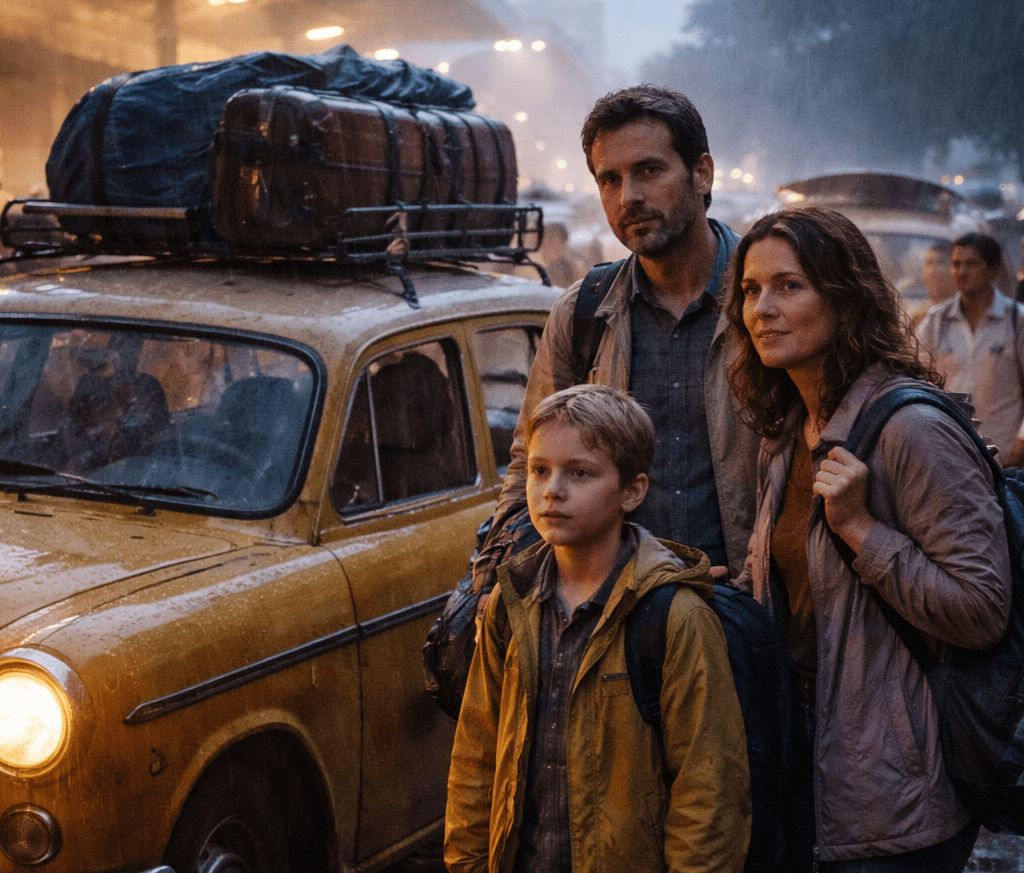
At dawn we stepped outside into chaos—people shouting, grabbing at our bags, offering to help for a tip. We found a taxi driver who nodded enthusiastically when we asked for the long-distance rank. He loaded our drenched luggage onto the roof and into the boot, and we set off, full of excitement and nervous hope.
The drive quickly became an initiation. We passed mile after mile of tar-paper shacks. People squatted along the roadside in the pouring rain, easing themselves in plain view. I had never seen poverty like this. The smell of India now carried another layer: the smell of hardship.
Then came the first complication. Our driver had no idea where the long-distance taxi rank was. Indians, we learned, rarely say “no” outright—even when they don’t understand, they agree enthusiastically and figure it out later. He stopped repeatedly to ask directions, leading to loud, gesticulating conversations with other drivers. We had little choice but to stay in the cab. The rain was relentless, our luggage was getting soaked on the roof, and abandoning the taxi in the middle of unfamiliar slums felt too dangerous.
Eventually we reached a sort of depot where dozens of drivers drank chai and shouted at one another. Our driver disappeared for a long time, then returned with another man who spoke a little English. The news was grim: the main road to Ganeshpuri was flooded and impassable. But for four times the normal fare, our driver would take the risk and try anyway. (Black-and-yellow taxis were licensed only within Bombay city limits; going rural could get him in serious trouble.) We were exhausted, jet-lagged, and desperate to reach the ashram. We agreed.
After more chai for the driver (nothing for us—we hadn’t eaten since the plane), we set off again. About an hour and a half later the car rolled to a stop—out of petrol. He disappeared with a bottle, returned with enough to limp to a garage, then confessed he had no money for fuel. We paid for a full tank. By now we had been travelling for over 24 hours straight.
We finally left the city behind and entered rural Maharashtra. Poverty here looked different but no less stark—people, pigs, chickens, dogs, and cattle all relieving themselves in the fields together, cheerfully and communally. Each person carried a small brass jug of water for cleaning afterward (always with the left hand, we later learned—the right hand for eating). The cultural differences were stark, but I still felt it was kind of an adventure.
After several more hours of slow driving, we hit a roadblock: the usual route to Ganeshpuri was flooded. A detour was possible via the back road near Vajeshwari, so we turned around and tried again.
Then disaster: the driver, impatient, hit a sacred cow at speed. The animal went down on its knees. Instantly a crowd gathered—shouting, gesticulating, angry. The car also had a flat tyre. There was no spare. We were stranded in the rain, in the middle of nowhere.
This felt like the low point. Just as we were resigning ourselves to being stuck, a car full of Indian devotees pulled over. They recognised us as Westerners heading to Ganeshpuri (in that part of rural India, that was the only reason foreigners appeared). They were on their way to an Intensive with Gurumayi, who—contrary to what we’d been told—had unexpectedly returned and was in residence after all.
They kindly offered to take mum and me the rest of the way. Dad would follow later with the luggage once the tyre was fixed. In our exhaustion and jet lag, we climbed in without thinking to take passports, money, or identification. Mum and I disappeared down the road in their car.
Dad paid for the tyre repair and caught up about an hour later. He arrived at the ashram gates to find mum in tears. The woman on gate duty—an officious volunteer—had refused us entry. Despite explanations that we were booked in, expected, and dad was following with all our papers, she was unrelenting. She wouldn’t let us use the toilets, wouldn’t give us water for medications, and directed us to a squat toilet across the road in a tea shop. It was our introduction to the kind of rigid, power-tripping behaviour we would encounter from some ashram “staff” volunteers in years to come. On that first day, it shocked us deeply.
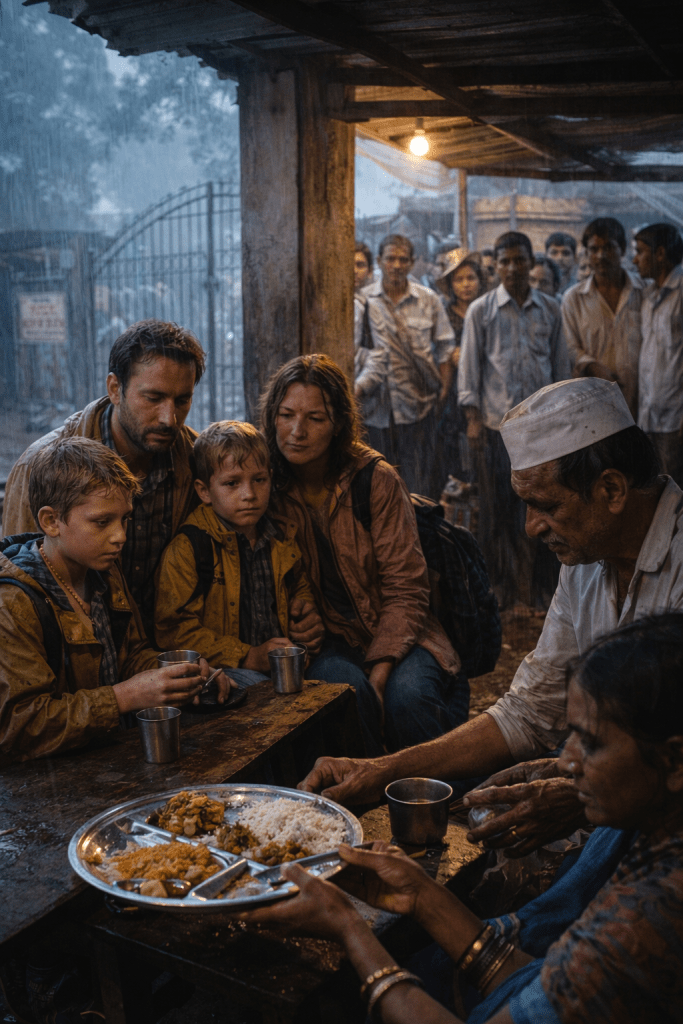
By now it was lunchtime. The gatekeeper locked us out until she had eaten. We crossed the road again and explained our situation to the tea-shop owners. They were kind beyond words—whipping up a meal on the spot despite the rain and chaos. A crowd gathered to watch the strange wet Western family eat. There were no forks; we were given a couple of teaspoons to share between the spiced vegetables and rice on a large silver tray. It was our first meal in India, eaten awkwardly and gratefully.
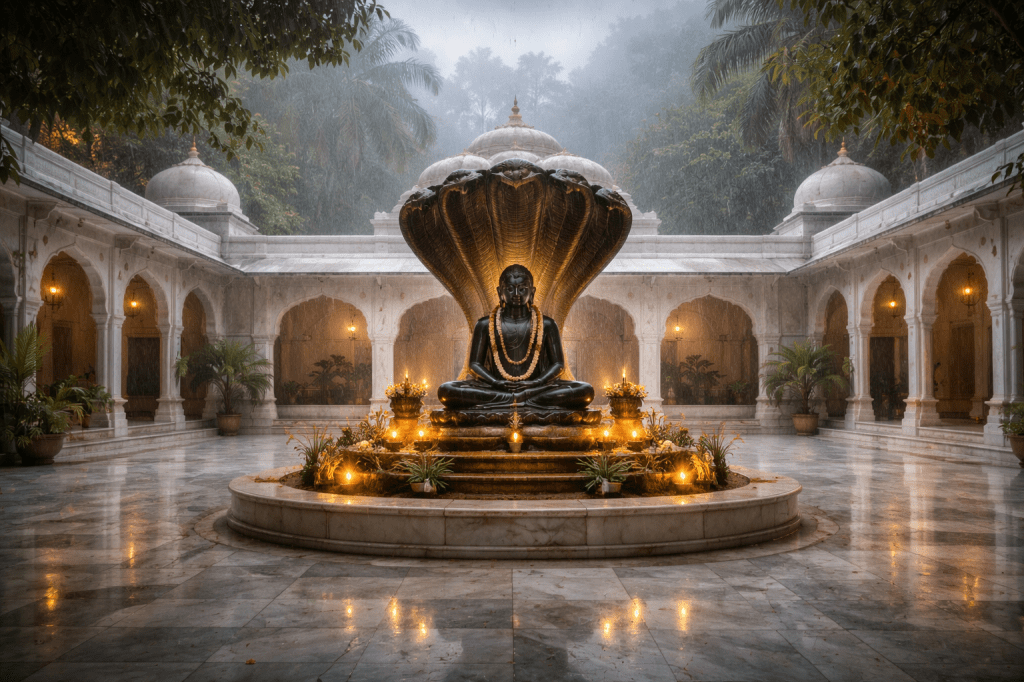
When the gate finally reopened, we walked through a grand stone arch into a beautiful white-marble courtyard. At its centre stood a black statue of Bhagavan Nityananda, sheltered under a huge stone cobra hood. Every evening devotees chanted there. The courtyard bordered Gurumayi’s residence, where she often sat giving darshan. People sat on the marble around her in a deep, heavy silence thick with shakti. mum later said it was her favourite place in the world—sitting silently at her guru’s feet in that courtyard.
We were exhausted, soaked, and emotionally raw. But we had arrived. The next morning my dad would take my hand and walk me to the samadhi shrine to pray.




Leave a Reply